
USE CASES / STUDENT AND FINANCIAL AID AI FORM FILLER
Fill Student and Financial Aid Forms Faster and Get Through Aid Season in One Sitting
Aid season is one long application, a tax statement your school sends you, and a credit form that reuses both. Simplicity AI turns the FAFSA PDF into a guided worksheet so your household answers everything once, then you carry it into fafsa.gov with nothing missing.
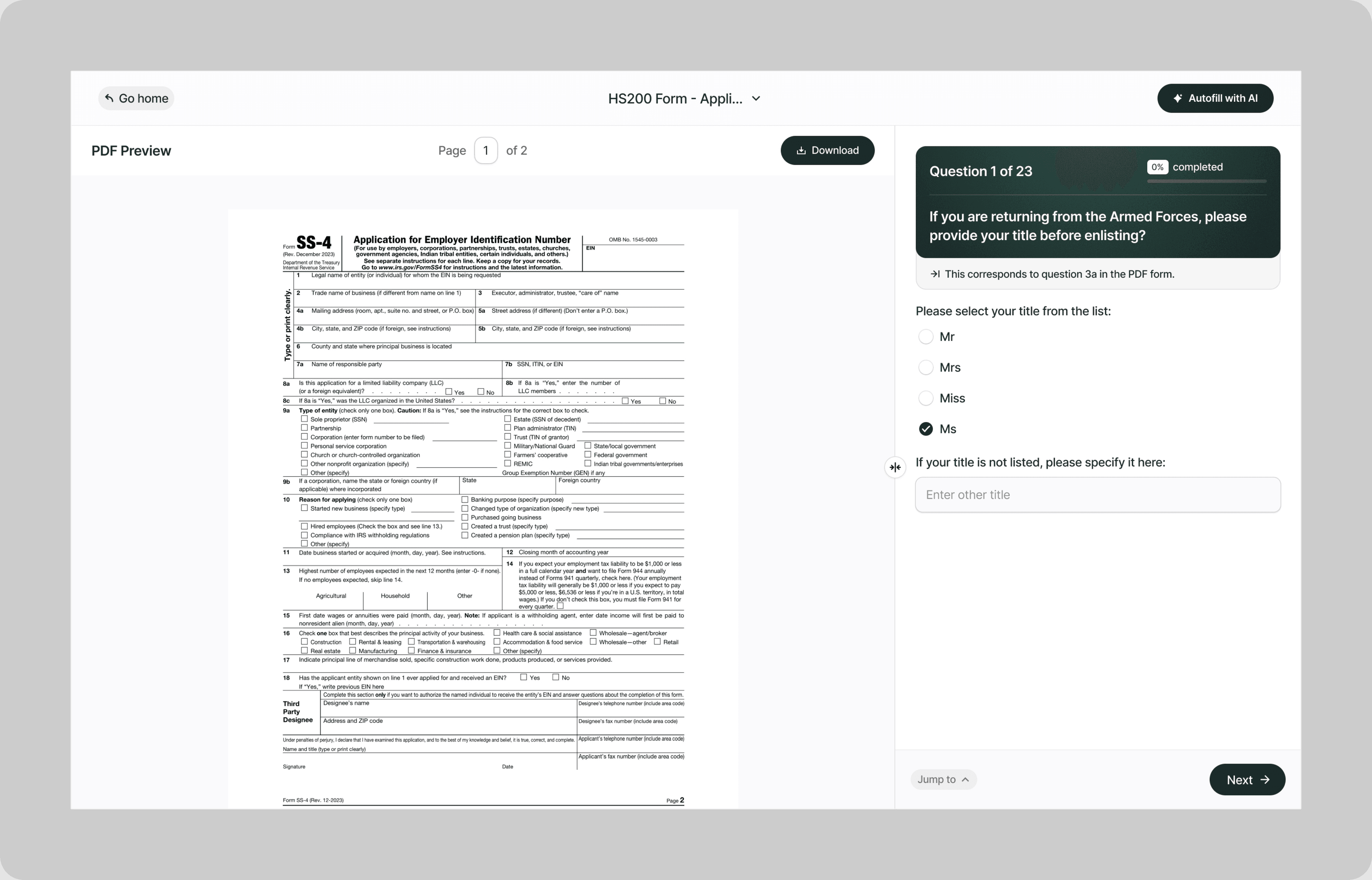
Paying for college runs on paperwork that arrives from three different places. The aid application comes from the Department of Education, the tuition statement comes from your school, and the tax credit form comes from the IRS. None of them talk to each other, and all of them want the same handful of figures.
Simplicity AI reads each PDF and turns it into plain-English questions. Your household details go in once and carry across every form, so the answers you give in October still line up with the ones you give in February.
The Problem with Student and Financial Aid Forms
- Aid paperwork is spread across a year, two households, and three agencies:
- The FAFSA needs information from a student, a parent, and sometimes a spouse, and each of them has to supply their own
- The 1098-T arrives from your school in January with figures you did not choose and cannot edit
- Form 8863 reuses those figures months later, once nobody remembers where the statement went
- School enrollment forms follow no federal standard, so every school asks in its own way
Miss something on any of it and the consequence is not a penalty notice. It is money you were eligible for and did not receive.
How Simplicity AI Solves It
- Simplicity AI treats aid season as one job rather than four. The AI:
- Turns the FAFSA PDF into guided questions your household can work through together before anyone opens fafsa.gov
- Stores the student and parent details once, so the same figures appear on every form that asks for them
- Reads your 1098-T and shows which box feeds which line of Form 8863
- Fills any school enrollment or registration PDF, whatever format your school uses
- Exports clean, signed PDFs to submit, upload to a school portal, or hand to whoever files your return
How to Fill Out Student and Financial Aid Forms Online Using Simplicity AI
1
Upload the form you need, or tell Simplicity AI where you are in the aid year and let it work out which ones apply.
2
Enter the student and household details once: legal names, Social Security numbers, addresses, and school.
3
Answer the questions the form asks, in plain English rather than in federal wording.
4
Sign in the browser, and bring in a parent to complete their part where the form asks for a second person.
5
Download a clean PDF to submit, upload to a school portal, or use as your worksheet when you key the FAFSA into fafsa.gov.
Key Benefits of Using Simplicity AI to Fill Student and Financial Aid Forms

One Set of Household Details
The student’s name, Social Security number, address, and school go in once and carry onto every form, so the aid application in October and the tax form in February do not disagree.

The FAFSA Worked Out Before You Submit
Fill the PDF as a worksheet with the household present, then key it into fafsa.gov knowing nothing is blank and nobody still owes you an answer.

1098-T Figures in the Right Place
Simplicity AI shows which box on the tuition statement feeds which line of Form 8863, including the school’s employer identification number that the credit asks for.

Two People, One Form
Aid paperwork needs a student and a parent. Each completes their own part and signs it, rather than one of them answering for the other.
Get the aid paperwork done while everyone is still in the same room.
[!! ƑÅǪş !!]
Frequently Asked Questions About Filling Student and Financial Aid Forms with AI
Can Simplicity AI submit my FAFSA for me?
No. The FAFSA is submitted at fafsa.gov, and Federal Student Aid says filing online is the fastest and easiest way to apply. Simplicity AI helps you work through the PDF first, so when you sit down at fafsa.gov every figure is already agreed and nothing holds you up.
Is there a paper FAFSA?
Yes. The 2026-27 paper application is pages 7 through 20 of the PDF, mailed to Federal Student Aid Programs, P.O. Box 70204, London, KY 40742-0204. Results arrive by email in three to five days if you provide an email address, or by post in about three weeks. Online is faster.
What is the deadline for the 2026-27 FAFSA?
The federal deadline is June 30, 2027. That is the last day of the award year the form covers, so by the time it arrives the school year is already over. Your state and your college set their own deadlines, far earlier, and those are the ones to work to.
Who counts as a contributor on the FAFSA?
A contributor is anyone whose information the form requires: the student, the student’s spouse, a parent, and a parent’s spouse or partner. Each person creates their own StudentAid.gov account, and Federal Student Aid is explicit that login credentials should not be shared with anyone.
Do I have to consent to the IRS transferring my tax information?
Yes. Federal Student Aid states that the student and all contributors must provide consent and approval for their tax information to be transferred to the FAFSA form. Without it, eligibility for federal student aid cannot be calculated.
Do I fill out Form 1098-T?
No. Eligible educational institutions file Form 1098-T for each student they enroll. You receive it, and you use the figures on it when you claim an education credit on Form 8863.
What is the difference between the American Opportunity Credit and the Lifetime Learning Credit?
Both are claimed on Form 8863. The American Opportunity Credit is worth up to $2,500 per student, and 40 percent of it, up to $1,000, is refundable. The Lifetime Learning Credit is worth up to $2,000 per return and is not refundable at all. Both phase out above certain income levels.
Is my family’s data safe on Simplicity AI?
Yes. These forms carry Social Security numbers, household income, and your school details. Simplicity AI encrypts your files, controls who can access them, and never shares your documents or uses your data to train AI models.
Common Student and Financial Aid Form Mistakes (and How AI Prevents Them)
Sharing one StudentAid.gov account between a student and a parent
Every contributor creates their own account, and Federal Student Aid says credentials should not be shared with anyone, including a financial aid administrator. A shared login is not a shortcut, it is a signature problem that surfaces later.
Skipping the consent step
Consent to transfer tax information is not optional. Federal Student Aid states that without it, eligibility for federal student aid cannot be calculated. The application can look finished on screen and still be going nowhere.
Treating the federal deadline as the real one
June 30, 2027 is the federal cutoff for the 2026-27 year, and it falls on the last day of the year the aid is for. By then the school year has been and gone. State and college deadlines land months earlier, and those are the ones that decide your award.
Filing an education credit around a missing 1098-T
Schools issue Form 1098-T, and in most cases the law expects you to have received one before claiming a credit. Narrow exceptions exist. Chase your school’s bursar rather than assuming the statement does not matter.
Leaving the school’s EIN off Form 8863
The American Opportunity Credit asks for the educational institution’s employer identification number. It is printed on the 1098-T, and it is the field people skip because it looks like the school’s business rather than theirs.
Defaulting to the Lifetime Learning Credit without checking
The Lifetime Learning Credit is capped at $2,000 per return and pays nothing back if you owe no tax. The American Opportunity Credit runs up to $2,500 per student and 40 percent of it, up to $1,000, is refundable. For an eligible undergraduate that gap is real money.
Retyping the same figures in three places from memory
The aid application, the tuition statement, and the credit form all reach for the same names, numbers, and school details across a span of months. Simplicity AI stores them once, so what you reported in October is what appears in February.

Small business form AI filler
Freelancer form AI filler
Ƥōƥũĺàŕ Ƒōŕmś
Ƥōƥũĺàŕ ƒōŕmś ŕēàďŷ ƒōŕ ŷōũ ţō ƒĩĺĺ Ĩńśţàńţĺŷ
Ƒĩńď ćōmmōńĺŷ ũśēď ĝōvēŕńmēńţ, ĺēĝàĺ, àńď ōƒƒĩćĩàĺ ďōćũmēńţś, àĺŕēàďŷ ōƥţĩmĩźēď ƒōŕ ƒàśţ, śţŕēśś-ƒŕēē ƒĩĺĺĩńĝ ŵĩţĥ Śĩmƥĺĩćĩţŷ ÀĨ. Ŵē'vē màďē ţĥēm ēàśĩēŕ, śmàŕţēŕ, àńď ƒàśţēŕ śō ŷōũ ćàń mōvē ōń ŵĩţĥ ŷōũŕ ďàŷ.
Ţàx Ƒōŕmś
Ĩmmĩĝŕàţĩōń Ƒōŕmś
Ĥēàĺţĥćàŕē Ƒōŕmś
Ēmƥĺōŷmēńţ Ƒōŕmś
Ĺēĝàĺ Ƒōŕmś
Mōţōŕ Vēĥĩćĺē Ƒōŕmś
Ēxƥēŕĩēńćē ĩńśţàńţ ƤĎƑ ƒōŕm ƒĩĺĺĩńĝ ŵĩţĥ ÀĨ
Ďēvēĺōƥēŕś
